

Journal Entry for Account Maintenance Fees
An account maintenance fee is typically charged by the bank on a monthly basis as long as the account stays open. This charge can sometimes be avoided depending on the bank’s waiver requirements. The most common way to prevent these charges would be to meet the required balance.
But for illustration purposes, let’s assume that XYZ Bank charged a monthly maintenance fee of $10 for our checking account. The journal entry to record this transaction is:

Notes on the entry:
- The bank service fees account is an expense account. Therefore, in order to record the expense, we debit the Bank Service Fees account for $10 and credit Cash for the $10 taken away by the bank.
- This entry is necessary when reconciling bank accounts because it often causes a difference in the book balance.
Journal Entry for Wire Transfer Fees
When you send payments to another bank account, the service usually charges a wire transfer fee. Typically, Wire transfer fees range from $0 to $35. The fee may vary depending on whether the transfer is domestic or international.
For illustration, let’s assume we wire transferred $500 to another individual to settle a debt. The wire transfer fee is $25.
Since the wire transfer fee is typically charged to the sender, the total amount of the cash withdrawn is $525 in this case. The journal entry to record the transfer is:

Notes on the entry:
- The wire transfer fee account is an expense account. Debiting $25 to an expense account means that we, the payor, have incurred the fee.
- The balance in accounts payable is the amount we originally owed to another party, which excludes the wire transfer fee. We debited A/P for $500 because we just settled the amount due by initiating the wire transfer, and we need to reverse the balance.
- The credit to Cash ($525) is the amount wired out ($500) plus the wire transfer fee ($25).
Journal Entry for Interest Charges
Banks charge interest if you don’t pay all of your credit card’s outstanding balance on the due date. For example, let’s assume XYZ Bank charged $50 interest charges on our outstanding credit card balance. The journal entry looks like this:

Notes on the entry:
Journal Entry for Overdraft/NSF Fees
If there is a fee that you should avoid, that fee would be the overdraft or NSF fee. When you try to withdraw more cash than what’s available in the account, the bank typically charges an overdraft or NSF fee. This fee is avoidable as long as you keep track of bank balances.
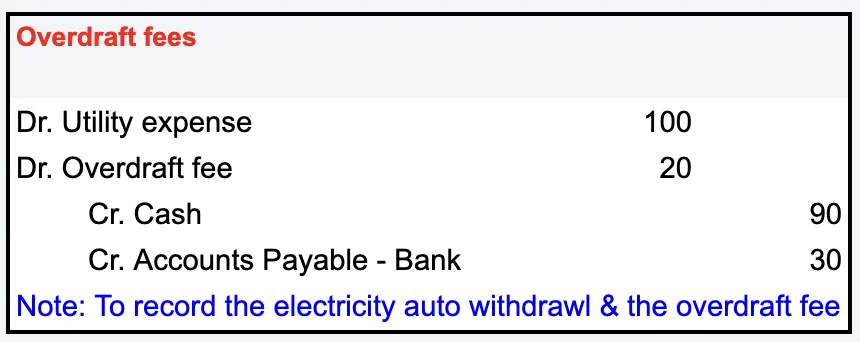
For example, when the electricity company auto-withdrew $100 out of our checking account while we only had a $90 balance available, the transaction still went through, and we incurred a $20 overdraft fee. The journal entry is:
Notes on the entry:
- The debit of $100 to the Utility expense account recognized the auto withdrawal by the electricity company. We still incurred and paid the $100 bill despite not having enough balance.
- The debit of $20 to the Overdraft fee is the amount charged for the said “penalty.” by our bank. It is an expense account.
- We credit Cash by $90 because that’s what was available in our checking account.
- We credit Accounts Payable – Bank for $30 because we now owe the bank $30, consisting of a $20 overdraft fee and a $10 “overdraft” balance ($100 withdrawn – $90 available balance).
- The overdraft fee is another common reconciling item that often prevents the bank and the book balance from being equal.
There is another similar scenario when the bank charges a fee; when we deposit a bounced or NSF check, the bank will typically pose a fee penalty against the recipient, even if it’s likely the payee’s fault. In that case, some companies will choose to treat it as a billable expense and ask for a refund from the payee. We have a dedicated article for this kind of scenario: Journal Entry for Bounced, Returned, NSF Check – Easy Guide
Journal Entry for Credit Card Transaction Charges
A credit card transaction charge is a fee deducted from the money that was sent to us, typically from a sale transaction.
For example, ABC Store sold a smartphone costing $1,000 to a customer. The customer used a credit card for payment. The payment processor charges 2% for credit card transactions.
The journal entry is:

Notes on the entry:
Journal Entry for ATM Fees
Banks charge ATM withdrawal fees for out-of-network transactions. These fees vary per bank. To illustrate, let’s say we withdrew $100 via ATM, and the bank charged $5 for the fee. The journal entry looks like this:

Notes on the entry:
- The debit to Cash on hand ($100) is the amount withdrawn from the ATM.
- The debit of $5 to Bank Charges is the withdrawal fee. It is an expense account.
- The credit to Cash in bank/checking account ($105) is the amount withdrawn ($100) plus the ATM fee ($5), because a total of $105 has been deducted from the checking accounting.
If the business does not maintain two cash accounts (Cash on hand vs. Cash in bank/checking account), the journal entry can be simplified as follows:

In this case, a simple $5 debit to Bank Charges and a $5 credit to Cash will balance the book since the net cash change is only $5.